
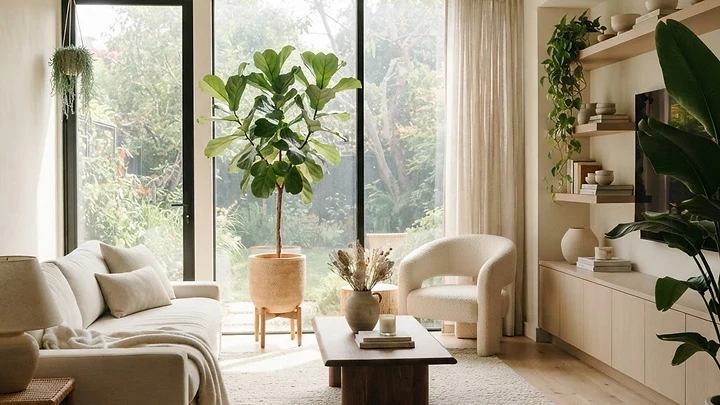
Beyond plants in pots
Biophilic design is often reduced to adding plants to a room. While plants are part of it, biophilic design is much broader. It is a design philosophy that seeks to reconnect people with the natural world through the built environment. It draws on the insight that humans evolved in nature and are healthier, happier, and more productive when our spaces reflect that origin.
The term was popularised by biologist E. O. Wilson, who argued that humans have an innate affinity for the natural world, which he called biophilia. Biophilic design translates this affinity into design principles, creating spaces that satisfy our deep need for connection to nature, even when we are indoors.
Three categories of nature
Biophilic design principles fall into three categories. Direct experience of nature includes actual plants, water features, natural light, and natural air movement. Indirect experience of nature includes natural materials like wood and stone, natural colours and patterns, and representations of nature like landscape imagery. Experience of space and place includes the arrangement of space in ways that mimic natural environments, such as sheltered refuges with wide views.
A well-designed biophilic space engages all three categories. A room with a plant (direct), a wooden floor (indirect), and a window seat that offers a view while providing a sense of shelter (spatial) is more restorative than a room with just a plant. The combination is what creates the deep sense of connection that biophilic design aims for.
Patterns from nature
One of the most powerful biophilic principles is the use of natural patterns, or biomorphic patterns. These are shapes and forms that recur in nature, like the spiral of a shell, the branching of a tree, or the hexagonal pattern of a honeycomb. When these patterns appear in design, in floor tiles, wall textures, or architectural details, the brain recognises them and responds with a sense of ease.
Another key principle is sensory variability. In nature, no two moments are the same. Light shifts, sounds change, textures vary. Biophilic design introduces this variability into built spaces through changing light, varied textures, and dynamic elements like water or moving air. A space that is sensorially rich is more engaging and more restorative than one that is uniform and static.
Designing for wellbeing
The goal of biophilic design is not aesthetic. It is human. Spaces designed with biophilic principles have been shown to reduce stress, improve cognitive function, support emotional wellbeing, and even speed healing in healthcare settings. The return on investment is not just in beauty but in the health and productivity of the people who use the space.
You can apply biophilic principles in any space, from a single room to an entire building. Start with what you have. Maximise natural light. Add plants. Use natural materials. Create a view. Introduce a water element. Layer textures. The more of these elements you bring together, the more the space will feel like a natural environment, and the more it will support the people in it.
Keep exploring
Frequently asked questions
Stay close to nature
Letters on living with nature, occasionally in your inbox.


Come closer
Let us bring nature closer to your space.
Tell us about your home, your terrace, your office, and how you would like it to feel.